
CO₂ Capture Cost Optimization
Optimized heat exchanger and absorber parameters — minimum temperature approach (ΔTmin), absorber stages and gas velocity — for MEA-based capture.
Aspen HYSYS v14PythonTEAIn-Plant Cost Estimator
▸ Chemical Process Engineer
▸ Aspen HYSYS Specialist
▸ CO₂ Capture Researcher
▸ Python Process Automation
▸ Techno-Economic Assessment
▸ Process Simulation & Optimization
Transforming urgent environmental challenges into sustainable engineering solutions through innovation, entrepreneurship, carbon management, waste valorization, and circular technology.

I am a Chemical Process Engineer with hands-on experience across process design, simulation, plant engineering, production supervision, cost estimation, and optimization — combining an M.Sc. from the University of South-Eastern Norway with several years of leadership and production roles in Nepal.
My master's work sits at the intersection of Aspen HYSYS simulation, Python-based automation, and techno-economic assessment for MEA-based CO₂ capture systems. I care deeply about turning rigorous simulation into decisions that reduce cost and carbon at industrial scale.
Growing up in Nepal, I witnessed how environmental challenges — from plastic waste and resource limitations to climate change affecting the Himalayas and Mount Everest — can directly impact ecosystems, communities, and livelihoods. Motivated to turn real-world problems into practical solutions, I launched my own manufacturing startup in 2019, developing cleaning products and hand-sanitiser formulations as demand surged during the COVID-19 crisis. That entrepreneurial experience shaped my approach as a chemical engineer: identify urgent global challenges and develop efficient, sustainable, and economically viable solutions. Today, my focus is on carbon capture, storage and utilisation, low-energy systems, waste valorisation, and circular technologies that create both environmental and societal value.
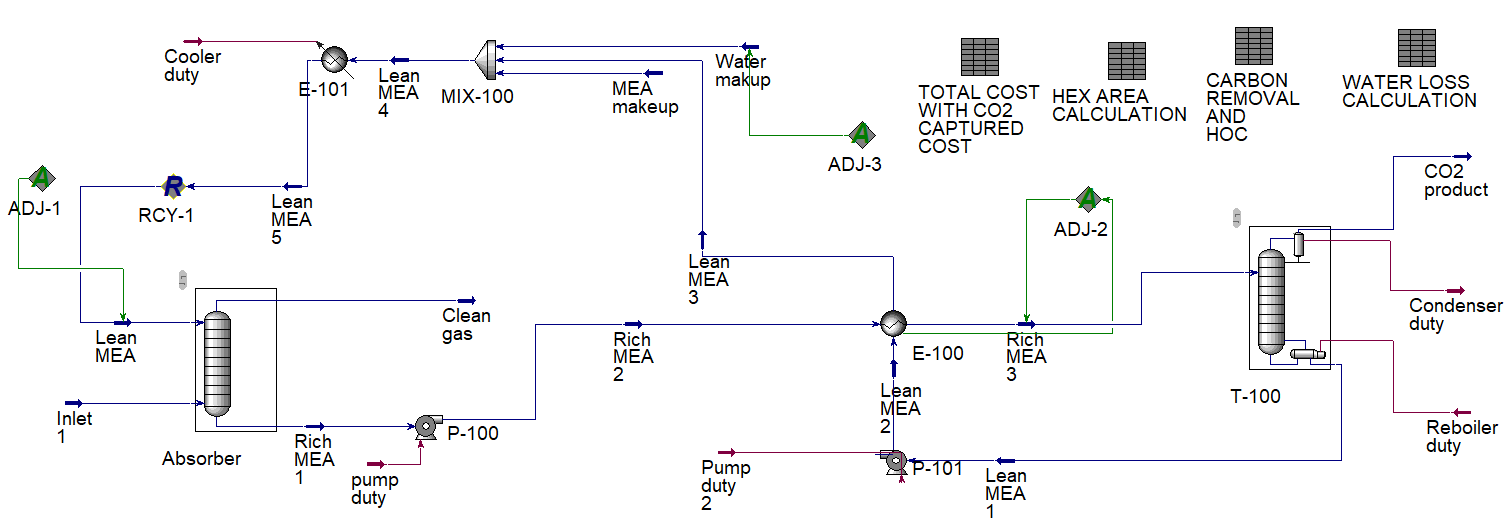
A rigorous Aspen HYSYS v14 model of MEA-based post-combustion CO₂ capture, coupled with Python to automate parametric studies and drive CAPEX, OPEX, capture cost and NPV optimization.
Supervisors: Prof. Lars Erik Øi & Dr. Solomon Aforkoghene Aromada · University of South-Eastern Norway · 2026
MEA-based CO₂ capture carries a significant energy and cost penalty; industrial deployment demands rigorous, automated techno-economic evaluation.
Minimize CO₂ capture cost while sizing absorber, desorber and heat exchangers under realistic performance and capture-efficiency targets.
Aspen HYSYS v14 model connected to Python; automated parametric sweeps over ΔTmin, absorber stages and gas velocity.
Absorber and desorber columns modeled at industrial scale; equipment sized via Aspen In-Plant Cost Estimator.
CAPEX, OPEX, CO₂ capture cost and NPV computed via Aspen spreadsheets, Python scripts, and power-law cost methods.
Automated pipeline identifies cost-optimal operating windows; framework extended to blended solvents in the SIMS 2026 paper.
Hover or tap to flip
Field visits · Industrial plants · Click for full photo
Simulation only becomes valuable when it meets the plant. Site visits to cement and fertiliser producers keep my models honest — walking the process, meeting operators, and tying every mass and energy balance back to real equipment.
Field build · Ion exchange · Hardness testing
Hands-on with a demineralization skid — FRP columns, PVC service manifolds and regeneration lines — validated with Aquasol titration for total hardness before the treated water goes downstream.
A snapshot of formulations, packaging and production lines shipped under the True Care Business Solution and B & B Foods brands — from disinfectants and toilet cleaners to extruded pasta.
Optimized heat exchanger and absorber parameters — minimum temperature approach (ΔTmin), absorber stages and gas velocity — for MEA-based capture.
Designed a stripping column with a three-stage energy-efficient plate heat exchanger system, reducing dissolved oxygen down to 5 ppb.
Developed single-unit PFD/P&ID documentation for urea plant design; worked on mixed-bed ion exchange integrated with RO water treatment.
MEA and MDEA/PZ solvent systems; absorber/desorber design and cost comparison.
Aspen HYSYS v14 and Aspen Plus workflows for rigorous steady-state modeling.
Coupling Aspen HYSYS with Python for automated parametric and cost studies.
CAPEX, OPEX, capture cost, and NPV via power-law and In-Plant Cost Estimator.
Column and heat exchanger sizing, ΔTmin studies, energy-efficient plate HX design.
Comparative analysis of MEA vs. blended amines for lower energy and cost.
Simulated CO₂ absorption and desorption using 29 wt.% MEA and a blended 30 wt.% MDEA / 20 wt.% PZ solvent in Aspen HYSYS v14 (absorber: 10 stages; desorber: 6 stages). Equipment sizing and cost estimation via Aspen In-Plant Cost Estimator at 85% CO₂ removal efficiency. Heat consumption: 3.77 MJ/kg CO₂ (MEA) vs. 3.65 MJ/kg CO₂ (MDEA/PZ). Capture cost: 31 €/t (MEA) vs. 28 €/t (MDEA/PZ) — showing the MDEA/PZ blend as a lower-energy, lower-cost alternative.
Authors: Lars Erik Øi*, Arash Khatapoosh Azar, Atlantic Bhandari, Kuleni Diriba, Solomon Aforkoghene Aromada, Neda Razi, Sumudu Shanaka Karunarathne · University of South-Eastern Norway
A print-ready CV with detailed coursework, experience, publications and a technical portfolio index.
Currently open to engineering, R&D, and doctoral positions worldwide. Response within 24 hours.